Year 2 Chemical Science - The Lost Bridge to Everleaf
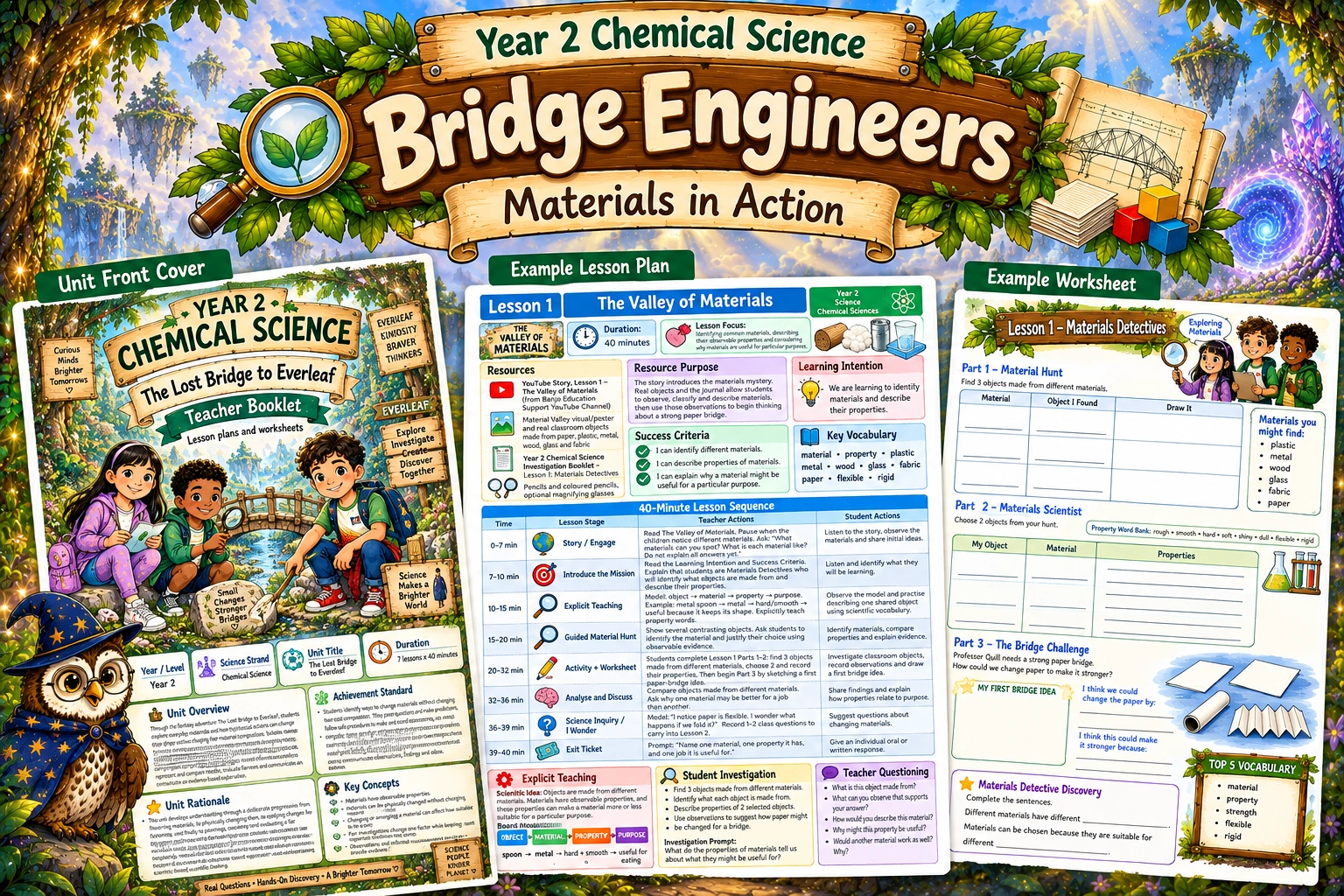
Year 2 Chemical Science Unit Plan
Through the fantasy adventure The Lost Bridge to Everleaf, students explore everyday materials and how physical actions can change their shape without changing their material composition. Students investigate how changes such as folding, bending, twisting, rolling, weaving and arranging can affect usefulness and strength. They then plan and conduct a safe, fair investigation comparing paper bridge designs, record informal measurements, represent and compare results, evaluate fairness and communicate an evidence-based explanation.
Year 2 Chemical Science Teacher Booklet and Journal PowerPoint
Use the Teacher Booklet to guide each lesson, with curriculum links, learning intentions, success criteria, vocabulary, explicit teaching, investigations, questioning and lesson sequences provided throughout the unit.
Use the accompanying Journal PowerPoint as a visual aid to display, model and explain each journal activity before students begin. This allows teachers to work through instructions, examples, investigations and recording expectations together while keeping the focus on teacher-led discussion and hands-on science learning.
Year 2 Chemical Science Student Journal
The Year 2 Chemical Science Student Journal guides students through their learning across The Lost Bridge to Everleaf unit. Students explore materials and their properties, investigate how materials can be physically changed, plan and conduct a fair test, record and compare results, create a class graph and use evidence to draw conclusions.
The journal builds towards the Bridge Engineers Expo, where students explain their scientific thinking, evaluate the fairness of their investigation, reflect on their learning and develop new questions for future investigations.
Lesson 1
Lesson 1 – Story Overview & The Valley of Materials
Begin the adventure with the Story Overview, where Mitchell, Lily and Oscar discover a mysterious map and are transported to the magical land of Everleaf. After meeting Professor Quill, they learn that the bridge across the Great Whispering Canyon has disappeared and they will need to use science to find a way home.
Their first stop is The Valley of Materials, where students become Materials Detectives, exploring different materials and describing properties such as hard, soft, smooth, rough, stiff, flexible, strong and weak. The story introduces the lesson’s science learning in an engaging context and finishes with Professor Quill’s challenge: Could something as simple as paper become strong enough to build a bridge?
Lesson 2 and 3
Lesson 2 – The Paper Forest
In The Paper Forest, Mitchell, Lily and Oscar discover that paper can be folded, rolled, twisted, scrunched, bent and flattened while still remaining the same material. As they experiment, they begin to notice something important — changing the shape of paper can change what it can do. This discovery brings them one step closer to solving their bridge problem.
Lesson 3 – The Builders’ Village
The journey continues to The Builders’ Village, where the children discover how materials can be changed and shaped to make them more useful for different purposes. Inspired by the builders, they create and explore different paper designs and begin thinking about how shape might affect strength. Their discoveries lead to their first investigation question: Which paper design will make the strongest bridge?
Lesson 4 and 5
Lesson 4 – Wisdom of the Forest Elders
Deep in Everleaf, the children meet the Forest Elders and learn how natural materials can be woven, twisted, plaited and coiled to create useful objects. They discover that changing the shape or arrangement of materials can make them better suited to a purpose. But before they can use their new knowledge, the mysterious Bridge Guardian appears with a challenge — their ideas must now be tested fairly.
Lesson 5 – The Scientist’s Challenge
At The Testing Grounds, Mitchell, Lily and Oscar learn what makes an investigation fair. They plan their bridge investigation by deciding what they will change, what they will keep the same and what they will measure. With their fair test planned, the doors to the Testing Grounds finally open — and the children are ready for the Bridge Trials.
Lesson 6 and 7
Lesson 6 – The Bridge Trials
The Bridge Trials begin! Mitchell, Lily and Oscar put their fair investigation into action, testing flat, folded, rolled and concertina paper bridges under the same conditions. They carefully observe, measure and record their results, then create a graph and compare the evidence to identify which design is strongest. They are no longer guessing — they are using evidence to make scientific conclusions.
Lesson 7 – The Bridge of Home
For their final challenge, the children use everything they have learned to build the Bridge of Home. They use evidence from their investigation to choose their strongest design, explain how changing the paper made it more useful, reflect on whether their test was fair and consider how they could improve or investigate further. With the bridge complete, Mitchell, Lily and Oscar finally return home — having learned not only about materials, but how to think like scientists.
Year 2 Chemical Science Posters
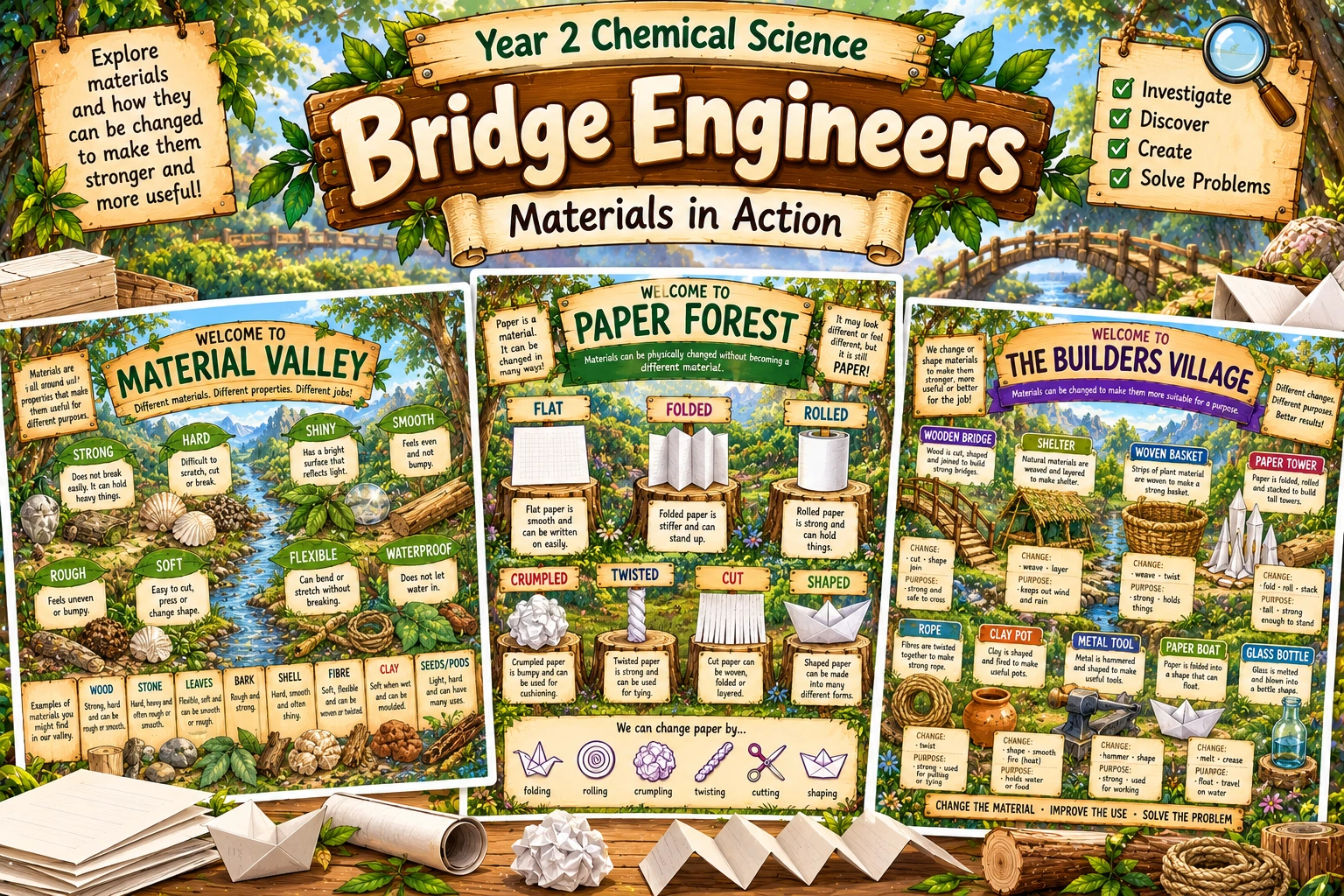
The Year 2 Chemical Science Posters visually follow students on their journey through The Lost Bridge to Everleaf. Each poster represents a new location or challenge from the story — from Material Valley and the Paper Forest, through The Builders Village, Forest Elders, Scientist’s Challenge and Bridge Trials, before finally reaching The Bridge of Home.
Display the posters as a learning wall throughout the unit, adding each one as the story progresses. They provide a visual reminder of the science concepts, vocabulary and investigations students have encountered, allowing the learning wall to grow alongside their journey through Everleaf.